Spinal Decompression vs Other Non-Surgical Back Pain Options
What motorized spinal decompression like the DRX9000 does, what the evidence and WHO guidance say, and a practical checklist for Saudi hospitals and clinics weighing the purchase.
Riyadh International Corporation
Editorial Team
Why this question matters for Saudi clinics
Low back pain is the leading cause of disability worldwide, according to the World Health Organization. For clinic owners and hospital procurement teams, that means steady demand for non-surgical options. It also means a steady stream of equipment proposals, including motorized spinal decompression systems. Before adding any of them to a capital plan, it helps to understand what the technology does, what the evidence says, and how it sits next to established care.
What motorized spinal decompression is
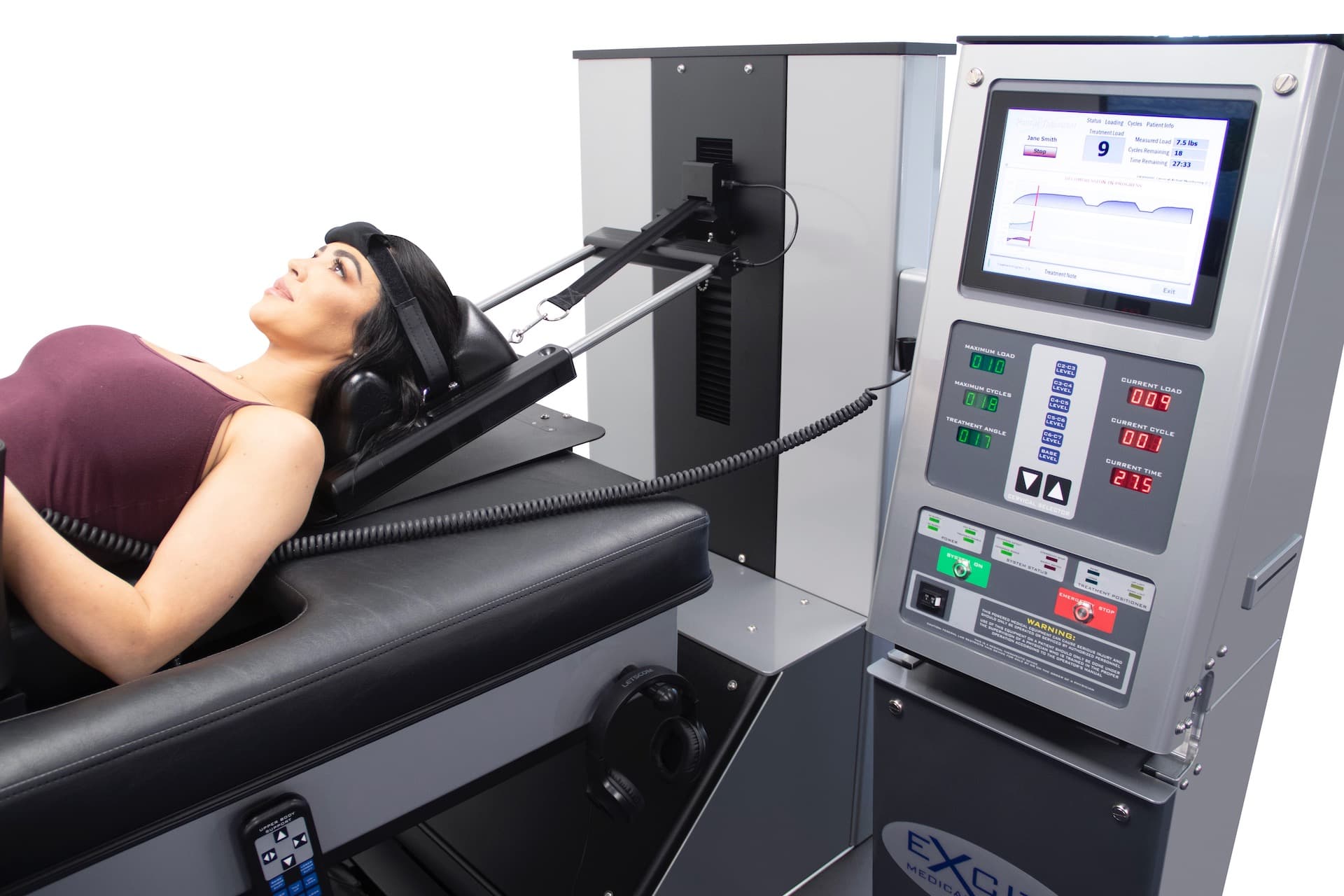
Motorized spinal decompression is a computer-controlled form of traction. The patient lies on a table with a pelvic harness, and the system applies graduated tension to the spine along a programmed treatment curve. According to the manufacturer, Excite Medical, the aim is to lengthen the spine without triggering the protective muscle guarding that can limit simple traction, and to reduce pressure inside the affected disc. Manufacturer descriptions also suggest that lower pressure in the disc space may encourage the movement of nutrients into the disc.
These are the manufacturer's explanations of the mechanism. They should be read as the rationale behind the design, not as proven clinical outcomes.
The DRX9000 in brief
The DRX9000 Combination System pairs the lumbar DRX9000 platform with a cervical attachment, so one system can be configured for both low back and neck treatment. Per the manufacturer's specifications, the system offers adjustable traction forces, patient monitoring with safety stop controls, and an ergonomic table with harness support. The listed indications include chronic low back pain, sciatica, herniated or bulging discs and degenerative disc disease. Excite Medical lists FDA 510(k) clearance for the DRX9000 and ISO 13485 quality management certification. Procurement teams should request the current regulatory documents directly and confirm the status of the specific model and configuration being offered for the Saudi market.
What the evidence actually says
This is the part of the conversation that deserves care. The published evidence on motorized decompression is mixed and, in several reviews, limited.
- A systematic literature review of motorized traction for chronic discogenic low back pain found that the studies without control groups reported large pain reductions, but concluded that the efficacy of the approach remained unproved.
- An evidence report prepared for the US Centers for Medicare and Medicaid Services concluded that the evidence at the time was too limited in quality and quantity to support evidence-based conclusions compared with other non-surgical treatments (see the HTA summary).
- Clearance by the FDA through the 510(k) pathway is based on substantial equivalence to an existing device. It is not by itself a demonstration of superior clinical outcomes.
Excite Medical's own leadership has acknowledged, as reported by NBC News, that more research on spinal decompression is needed. A balanced view is that the technology is established in the market, widely used in private practice, and still waiting for the kind of large, high-quality trials that would settle the debate.
How it fits among non-surgical options
The WHO published its first guideline on non-surgical management of chronic primary low back pain in December 2023, aimed at primary and community care. It reviewed 37 interventions and made recommendations on most of them. The options it supports include education, exercise programs, some physical therapies such as spinal manipulative therapy and massage, psychological therapies such as cognitive behavioural therapy, and certain medicines such as NSAIDs. Among the interventions it does not recommend for most people in most contexts are lumbar braces and supports, traction, and opioid painkillers (see the WHO guideline summary).
That is a significant point for anyone evaluating decompression equipment. The guideline is aimed at primary and community care and addresses chronic primary low back pain, so it does not directly assess every device or every patient group. It does, however, signal that traction-based approaches are not first-line in this guidance, and that a combination of education, exercise and other interventions is generally preferred over any single treatment.
Which patients might a clinician consider it for?
Decisions about patient selection belong to treating clinicians and should follow local clinical protocols. In general terms, manufacturer indications focus on chronic low back or neck pain associated with disc conditions or sciatica. Clinics that offer decompression typically position it as one component of a broader programme, alongside exercise-based rehabilitation and patient education, rather than a stand-alone solution. Appropriate screening, contraindication checks and informed consent are essential, and patients who do not improve should be reassessed.
A practical checklist for procurement and biomedical teams
- Clinical fit. Ask your clinical leads which patient pathway the system would serve, and how outcomes would be measured.
- Evidence review. Read the primary literature and current guidelines, not only manufacturer brochures. Plan to audit your own outcomes after installation.
- Regulatory status. Confirm the registration and approval status required in Saudi Arabia for the exact model offered, and obtain documentation.
- Space and installation. The DRX9000 Combination System is a large, heavy unit. The manufacturer lists a weight of roughly 1,780 lbs (about 807 kg) and a footprint of about 126 by 32.5 inches, so confirm room dimensions and floor loading with your facilities team.
- Training and service. Confirm operator training, preventive maintenance, spare parts and response times before purchase.
- Throughput and economics. Model realistic session lengths, treatment courses and utilisation. Avoid assumptions that are not based on your own patient volumes.
The takeaway
Motorized spinal decompression is a real and established product category, and the DRX9000 is a well-known system within it. But the evidence base is contested, and major guidance for chronic low back pain currently favours education, exercise and other multimodal care. For hospitals and clinics in the Kingdom, the sensible approach is to treat decompression as an adjunct, evaluate it against your own patient needs, and make the purchase decision on documented evidence, regulatory status and service capability.
If you would like technical specifications, regulatory documentation or a conversation about whether a system fits your facility, contact Riyadh International Corporation at https://ricmedical.com.sa/contact.
Looking for advanced medical equipment for your facility?
RIC has been supplying Saudi hospitals and healthcare facilities with cutting-edge medical solutions since 1985. Our team of specialists will help you find the right equipment for your needs.
About the Author
Riyadh International Corporation
Editorial Team
Expert at Riyadh International Corporation with deep knowledge in medical equipment distribution and healthcare solutions across Saudi Arabia.